Water heaters
Tank vs. Tankless Water Heaters: Which Fits Your Home?
A tank water heater stores hot water and keeps it ready; a tankless unit heats water only while a tap is open. Neither is automatically better. The right choice comes down to how much hot water your household uses at the same time, what your home can support for gas, power and venting, and how long you plan to stay.
What is the real difference between tank and tankless?
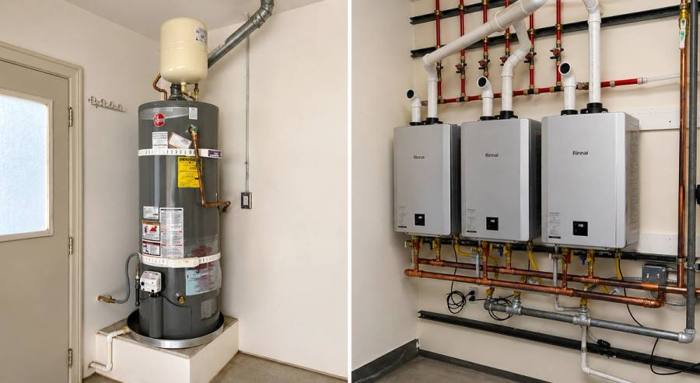
A tank heater keeps a set volume of water hot, commonly 40 to 50 gallons in a home. When you use a lot at once, you draw the tank down and then wait for it to recover. It also uses some energy keeping stored water hot when nobody is using it.
A tankless heater has no storage. When you open a hot tap, it fires up and heats water as it flows through. It will not run out the way a tank does, but it has a maximum flow rate. Ask too many fixtures for hot water at once and the temperature or flow drops.
| Tank | Tankless | |
|---|---|---|
| How it heats | Stores and reheats a set volume | Heats water as it flows |
| Runs out? | Yes, until it recovers | No, but has a maximum flow rate |
| Space | Floor space for the tank | Usually wall-mounted |
| Install changes | Often a like-for-like swap | May need gas, venting or electrical work |
| Routine care | Flush sediment, check anode rod | Descale and clean inlet filter |
How do I know what size my household needs?
Think about your busiest ten minutes, not the number of people in the house. Two showers running while the dishwasher fills is a very different demand from one person showering in the morning.
- Tank heaters are compared by capacity and how fast they recover.
- Tankless heaters are compared by gallons per minute at a given temperature rise. The colder the incoming water, the less hot water a unit can deliver.
- Write down which fixtures you run together. That list is the most useful thing you can bring to a sizing conversation.
Can a tankless unit go where my old tank is?
Sometimes, but swapping equipment type is usually more than a one-for-one swap. Gas tankless units often need a larger gas supply and a different kind of venting than an old tank heater. Electric tankless units can need significant electrical capacity. The location, clearances and water connections all matter too.
That is why two quotes can look very different. One may include gas line, venting or electrical work that the other leaves out. Compare the whole job, not just the price of the unit.
Will tankless give me hot water instantly?
Not by itself. The water sitting in the pipe between the heater and your faucet still has to run out before hot water arrives. A bathroom far from the heater will feel just as slow with either type. If the wait at one faucet is your main problem, say so. That is a delivery question, not a heater-size question, and the answer may be different.
How long do they last, and what maintenance do they need?
Many tank heaters last roughly 8 to 12 years. Tankless units are often rated to last longer, but only with regular maintenance. Water quality matters a lot here, and much of San Diego County has hard water, so mineral scale is a real concern for both types.
- Tank: flush sediment from the bottom periodically and have the anode rod checked. The anode rod is a metal rod that corrodes so the tank does not.
- Tankless: descale (flush the heat exchanger) on the schedule in the manufacturer’s instructions, and clean the inlet filter.
- Both: know where the water and gas or power shutoffs are, and never cap or block the temperature and pressure relief valve.
Repair or replace?
Water pooling under a tank, especially from the bottom, usually means the tank itself has failed, and a leaking tank cannot be patched. Problems like a pilot that will not stay lit, a bad thermostat or element, or a faulty valve can often be repaired. Age, how often it has needed work, and whether it still meets your household’s demand all go into the decision.
Quick answers
Frequently asked questions
Do you work on both tank and tankless water heaters?
Yes. San Diego Plumbing and Drain repairs, replaces and installs tank and tankless water heaters, gas and electric, and offers maintenance and flushing.
Can I pick a heater size from household size alone?
It is a starting point, but overlapping use matters more. Two people who shower at the same time can need more than four people who do not.
Is a leaking water heater an emergency?
A small drip still needs attention soon. If water is spreading, turn off the cold water supply to the heater and its gas or power, then call. Emergency service is available 24/7.